While the Gameboy has a decent range, when exploring influences such as dubstep and drum and bass, composers often want to go lower, to get deeper, fuller bass.
While artificial pitch shifting can be achieved easily with computers, it usually results in artifacts and leaves the sound not as good as it could be.
This is where underclocking becomes a good option.
The following video presents one clock changing option, giving the user realtime control over clock speed.
However, the more popular(and easier) option, is to change the crystal oscillator, from 4.194304MHz to 2.097152MHz, although due to the difficulty in finding 2.097152MHz crystals, 2MHz is usually accepted,(the machine stays intune with itself, but is slightly off others)
A guide to this method is available here http://gieskes.nl/underclocking_or_overclocking_the_gameboy_classic_tutorial/
This guide also presents the idea of overclocking, allowing the Gameboy to play at faster speeds and higher pitches.
And here is a song made by Sydney chiptuner Ten Thousand Free Men and Their Families that was written on an underclocked DMG using LSDJ
Showing posts with label gameboy. Show all posts
Showing posts with label gameboy. Show all posts
Monday, July 13, 2009

Monday, July 6, 2009
midi sync update
A few months ago I traded off an unused drum machine to a member of 8 bit collective in return for a midi>gb sync.
More than 6 months later, I assumed it had been lost in the post, or that I had encountered a particularly shifty individual. This led me to investigate the arduinoboy, which I built in the end.
But this morning, I received a surprise in the mail.
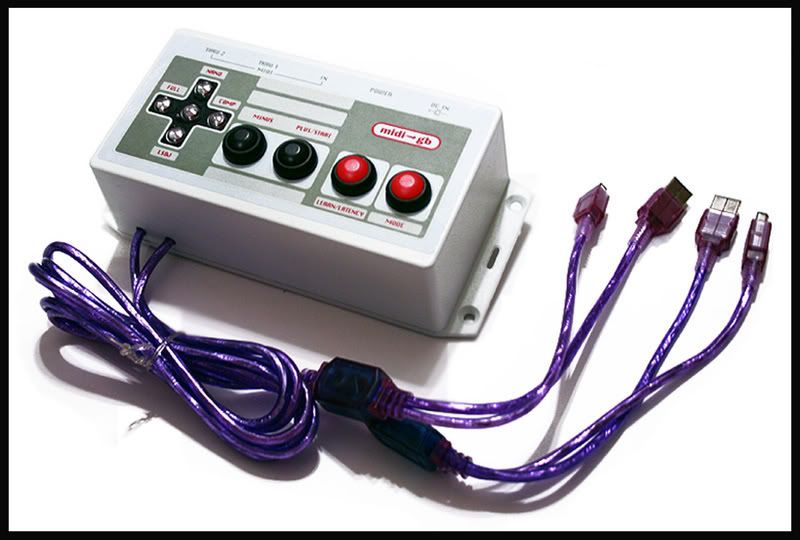
A lowgain midi>gb sync. 8bc member, and chip artist lowgain(Logan Erickson) produced a small run of these in 2008, based off the original design by FirestARTer(http://www.firestarter-music.de/lsdj/)
This device functions much like the arduinoboy, including 4 of the 5 modes(MGB support is missing). It is also contained within a much sturdier case than my arduinoboy, and much less prone to freezing on mode 2, and becoming unresponsive as my arduinoboy occasionally did(for reasons i was unable to identify).
Furthermore it contains 2 midi thru ports allowing further support of other devices.
I also received a new clear DMG, bringing my count up to 4 DMGs and 2 GBCs.
With my upcoming performance at the National Campus Band Comp, multiple consoles will come in useful for segueing between songs.
I also received a new clear DMG, bringing my count up to 4 DMGs and 2 GBCs.
With my upcoming performance at the National Campus Band Comp, multiple consoles will come in useful for segueing between songs.
More than 6 months later, I assumed it had been lost in the post, or that I had encountered a particularly shifty individual. This led me to investigate the arduinoboy, which I built in the end.
But this morning, I received a surprise in the mail.
A lowgain midi>gb sync. 8bc member, and chip artist lowgain(Logan Erickson) produced a small run of these in 2008, based off the original design by FirestARTer(http://www.firestarter-music.de/lsdj/)
This device functions much like the arduinoboy, including 4 of the 5 modes(MGB support is missing). It is also contained within a much sturdier case than my arduinoboy, and much less prone to freezing on mode 2, and becoming unresponsive as my arduinoboy occasionally did(for reasons i was unable to identify).
Furthermore it contains 2 midi thru ports allowing further support of other devices.
I also received a new clear DMG, bringing my count up to 4 DMGs and 2 GBCs.
With my upcoming performance at the National Campus Band Comp, multiple consoles will come in useful for segueing between songs.
I also received a new clear DMG, bringing my count up to 4 DMGs and 2 GBCs.
With my upcoming performance at the National Campus Band Comp, multiple consoles will come in useful for segueing between songs.
Friday, April 17, 2009
Demo Scene.
The demoscene is as important for the computer industry as street soccer is for the professional world of soccer. It is the breeding place for very talented programmers, musicians and graphicians. Stimulating young artists (programmers, musicians and graphicians) to measure their skills with others and to learn from eachother.(http://www.scene.org/demoscene.php)
It basically started with cracking games on home computers in the
early 1980s (at least this is widely regarded to be the main root of the scene as we know it today). Crackers started to remove the copy protection of games for fun and competition with other crackers. Instead of just spreading the cracked games, they soon thought about 'labeling' their releases. Modified versions of title screens (saying "cracked by xyz") were soon followed by a more advanced version of showing the cracking/programming skill of a cracker: The crack-intro. Visual effects, music and long text scrollers filled with greetings and scene babbling. Later, cheat modes ("trainers") followed. Of course those kind of activities were (and still are) barely legal, so the crackers used pseudonyms instead of their real names...
...In the late 1980s the legal part of the cracking and warez scene slowly drifted away from the illegal part. Intros became more advanced, (mega-)demos (several advanced intros linked together) appeared. The demoscene was born... sort of. A few individuals are still active in both, demoscene and warez/cracking scene.
(http://tomaes.32x.de/text/faq.php#2.3.)
While demos began mainly on the Amiga, Commodore and Atari platforms, these days it has diversified to almost every platform imaginable.
This page, specialises in Gameboy demos, which can be uploaded to a flash cart, or run in an emulator, like Visual Boy Advance
Tuesday, April 14, 2009
Gameboys
The following is a very brief history of Nintendo's Gameboy line.
The original Nintendo Gameboy(refferred to as the DMG) was introduced by Nintendo in 1989, since then, many newer updated models have been released, ranging from the original DMG's dot matrix screen and lo-fi sound processor, to the most recent Dsi with dual backlit screens, touch screen interface, and ability to play back cd quality sound files.
The original Nintendo Gameboy(refferred to as the DMG) was introduced by Nintendo in 1989, since then, many newer updated models have been released, ranging from the original DMG's dot matrix screen and lo-fi sound processor, to the most recent Dsi with dual backlit screens, touch screen interface, and ability to play back cd quality sound files.
An overview of the consoles specs can be found on wikipedia.org, but here are some of the more important features.
CPU: Custom 8-bit Sharp LR35902 core at 4.19 MHz which is similar to an Intel 8080 in that all of the registers introduced in the Z80 are not present.
Sound: 2 Square Waves, 1 programmable 32-sample 4-bit PCM Wave, 1 White noise, and one audio input from the cartridge. The unit only has one speaker, but headphones provide stereo sound.
Screen size: 66mm (2.6 in) diagonal
Communication: Up to 2 Game Boys can be linked together via built-in serial ports, up to 4 with a DMG-07 4-player adapter. More than 4 players is possible by chaining adapters.
The console itself is quite limiting in what can be done with it in this respect. 4 channels of audio, one of noise(generally referred to as a pseudo-random noise generator rather than specifically white noise), and such a tiny screen size make this a much less versatile and usable platform than a modern computer.
Usability becomes a further issue when forced to navigate menus and software using the simple controller layout of the console, which consists of a 4 direction pad, “a” and “b” buttons, as well as “start” and “select” buttons.
This layout however has proved itself quite usable in software such as LSDJ and Nanoloop, the most commonly used software for creating music on the console.
In 1995, the Gameboy Pocket was released, which featured hardware as the DMG, but in a slimmed down case, and with a black and white screen, instead of the DMG's “shades of green.” This particular console is notorious for having a noisier output than most others.
Almost 10 years after the DMG's release, Nintendo released the console's follow up, the Gameboy Colour.
The Gameboy Colour(GBC) featured a colour screen, capable of showing 56 colours simultaneously from a possible 32,786. It also made use of a processor twice as fast as its predecessors.
In 2001, the Gameboy Advance(GBA) was released. With an upgrade to a 32bit processor, as well as backwards compatability with older software and sound synthesis using an 8/4mhz Z80 clone as was used in previous models. It also featured a bigger screen, ability to show more colours, and two new shoulder buttons, allowing more control options. However, a new link cable port meant it was not possible to interface with older models. Like the DMG and Gameboy Pocket, the GBA received updates in the form of the Gameboy SP, with smaller size, and backlit screen, and the Gameboy Micro, which left behind backwards compatability, for a much smaller size.
The follow up to the GBA series, was the Nintendo DS (NDS) which incorporated a dual screen system, with one of the screens having touch screen capabilities. It also featured improved backlight, and dual processors running at 67 and 33mhz. By this stage, sound production was far beyond the simple hardware based synthesis of the DMG.
Sebastian Tomczak's comparison of sound quality of various Gameboy models can be found here (http://www.milkcrate.com.au/_other/gbc/content.html)
Subscribe to:
Posts (Atom)