Today seemed like an appropriate day to start finishing my album.
It's a collection of 6 of my best recent tracks, and can be found online here.
http://milkcrate.com.au/godinpants/godinpants-areyouwithus.zip
It features a reasonable amount of variance, some nanoloop, underclocked sounds, sampled drums in LSDJ, re-sampled sounds sequenced using a monome.
I'm pretty happy with it. I've printed up some covers and will be handing them out at my upcoming performance at the campus band comp.
Showing posts with label LSDJ. Show all posts
Showing posts with label LSDJ. Show all posts
Monday, July 27, 2009

Monday, July 6, 2009
midi sync update
A few months ago I traded off an unused drum machine to a member of 8 bit collective in return for a midi>gb sync.
More than 6 months later, I assumed it had been lost in the post, or that I had encountered a particularly shifty individual. This led me to investigate the arduinoboy, which I built in the end.
But this morning, I received a surprise in the mail.
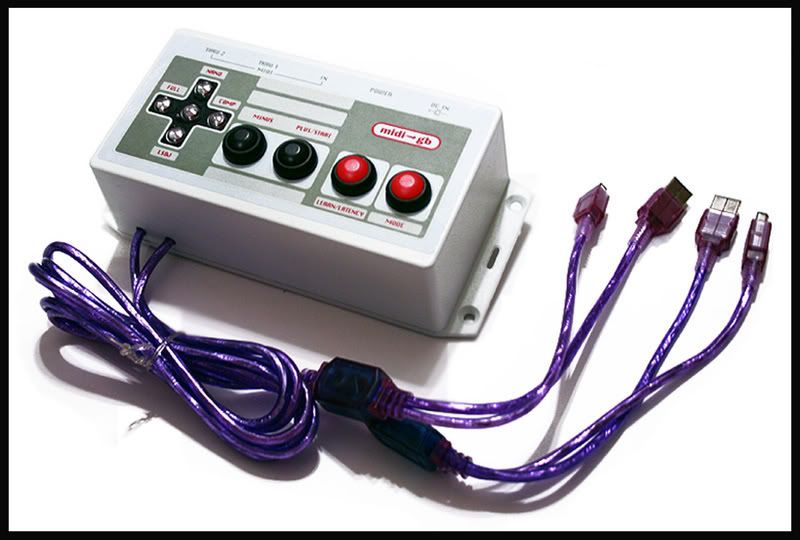
A lowgain midi>gb sync. 8bc member, and chip artist lowgain(Logan Erickson) produced a small run of these in 2008, based off the original design by FirestARTer(http://www.firestarter-music.de/lsdj/)
This device functions much like the arduinoboy, including 4 of the 5 modes(MGB support is missing). It is also contained within a much sturdier case than my arduinoboy, and much less prone to freezing on mode 2, and becoming unresponsive as my arduinoboy occasionally did(for reasons i was unable to identify).
Furthermore it contains 2 midi thru ports allowing further support of other devices.
I also received a new clear DMG, bringing my count up to 4 DMGs and 2 GBCs.
With my upcoming performance at the National Campus Band Comp, multiple consoles will come in useful for segueing between songs.
I also received a new clear DMG, bringing my count up to 4 DMGs and 2 GBCs.
With my upcoming performance at the National Campus Band Comp, multiple consoles will come in useful for segueing between songs.
More than 6 months later, I assumed it had been lost in the post, or that I had encountered a particularly shifty individual. This led me to investigate the arduinoboy, which I built in the end.
But this morning, I received a surprise in the mail.
A lowgain midi>gb sync. 8bc member, and chip artist lowgain(Logan Erickson) produced a small run of these in 2008, based off the original design by FirestARTer(http://www.firestarter-music.de/lsdj/)
This device functions much like the arduinoboy, including 4 of the 5 modes(MGB support is missing). It is also contained within a much sturdier case than my arduinoboy, and much less prone to freezing on mode 2, and becoming unresponsive as my arduinoboy occasionally did(for reasons i was unable to identify).
Furthermore it contains 2 midi thru ports allowing further support of other devices.
I also received a new clear DMG, bringing my count up to 4 DMGs and 2 GBCs.
With my upcoming performance at the National Campus Band Comp, multiple consoles will come in useful for segueing between songs.
I also received a new clear DMG, bringing my count up to 4 DMGs and 2 GBCs.
With my upcoming performance at the National Campus Band Comp, multiple consoles will come in useful for segueing between songs.
Wednesday, June 3, 2009
Arduinoboy Completion.
I recently completed an arduinoboy(which can be found at http://code.google.com/p/arduinoboy/), after a fair bit of messing around trying to make it work.
As it turns out, the main problems were the following;
1. I had a few of the pins on the gameboy cable wrong.
2. In an attempt to make it work I'd put the optocoupler in backwards(rendering it dead it appears.)
3. When these things were fixed, I'd neglected to notice my midi connector was upside down, so the leads to that were backwards.
I fixed all these and have since been playing around with it, mostly as a MIDI clock for LSDJ, although it does have a keyboard mode, and a full midi mode of MGB, which I will play with later.
For now though, I have been using this ability to sync my gameboy with cut up breakbeats running in Puredata, so that I could add not only a new group of sounds to my music, but a new level of performativity with the function of a controller I built for PureData.
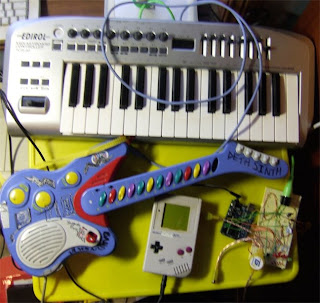
The controller(left), a Gameboy(center), the Arduinoboy(far right), and my midi interface(top)
Here is a screenshot of the patch.

Which you can download here.
I made THIS song using the gameboy, connected to the patch using the arduinoboy.
As it turns out, the main problems were the following;
1. I had a few of the pins on the gameboy cable wrong.
2. In an attempt to make it work I'd put the optocoupler in backwards(rendering it dead it appears.)
3. When these things were fixed, I'd neglected to notice my midi connector was upside down, so the leads to that were backwards.
I fixed all these and have since been playing around with it, mostly as a MIDI clock for LSDJ, although it does have a keyboard mode, and a full midi mode of MGB, which I will play with later.
For now though, I have been using this ability to sync my gameboy with cut up breakbeats running in Puredata, so that I could add not only a new group of sounds to my music, but a new level of performativity with the function of a controller I built for PureData.

The controller(left), a Gameboy(center), the Arduinoboy(far right), and my midi interface(top)
Here is a screenshot of the patch.

Which you can download here.
I made THIS song using the gameboy, connected to the patch using the arduinoboy.
Wednesday, May 27, 2009
Newer Compositions
I've come up with two more compositions recently, both short songs, based around simple ideas, but I've been trying out some new things.
On this track, Striving for Sonic Mediocrity I played around first with the speech synthesis capabilities of lsdj, making it speak out "godinpants" the name I produce under.
I also began making use of the noise channel, while I couldn't come up with much for it, I was later directed to this page the LSDJ patchbook which I made use of later.
When it came to recording this track, I panned the pulse channels, and wave synth left, and the wave kits, and noise channel right. This meant I could apply different compression to the drums, which I think really stand out well on this track.
In the second track, sun-chaser I created all my percussive parts using the noise channel, with instruments modified from things i found on the previously mentioned patchbook.
This freed up the wave channel to play synth parts(although it mostly performs harmonies with the pulse channel, which should lead to a lot more options melodically in future.
Monday, May 11, 2009
Reflection - Software.
Why am I using the software i am?
The main pieces of software i intend on using on the gameboy are as follows, LittleSoundDJ, Nanoloop 1.3 and the “Trippy H” sequencer found on the gameboy camera peripheral.
The first, LSDJ is usually considered the more advanced of the three, allowing more control over sounds produced and sequences, the ability to string sequences together, and use of the wave channel as either a synth or sample player. LSDJ also allows the use of a modified PS2 computer keyboard as a keyboard controller for the software, meaning users can step outside the general gameboy interface. The song arrangement screen makes LSDJ one of the more “musical” of the three, because users can write out an entire song and let it play back, or use “live” mode where chains of phrases can be selected. I have been using LSDJ primarily, due to the complexity of patterns it allows. I can write longer songs, with a stronger structure than i would in the other software mentioned here. I am also quite drawn towards using the sampled drumkits within the software, there is a challenge of writing original sounding beats, while utilising a maximum of 2 samples at a time, with samples having any kind of decay cut off when the next sample begins, it creates a simplicity in what can often be complex patterns.
Nanoloop is a much more simplified sequencer. It really lends itself to creating music from short loops, and live performance. Unlike the LSDJ pattern selector that only allows a user to choose phrases within the one song, or save file, Nanoloop allows a user to access all saved phrases and swap between them, either one at a time, or a whole “column”. Unlike LSDJ which makes use of the wave channel as a sample player, Nanoloop contains a “special”wave channel, where a custom waveform can be played back. This does though, force users to create all drum sounds with either the noise channel, or a combination of a pulsewave kick and noise high hats/snares. I feel like this leaves Nanoloop creating more “authentic” game sounds, leaving behind the sampled kits used by LSDJ.(However Gameboy games did occasionally make use of the sample playback ability of the wave channel) I enjoy using nanoloop, because it allows a certain level of improvisation, which i feel is important in the way i create music. It is this same feature though, that sometimes limits me from “finishing” songs, most of my music written in nanoloop never really reaching a finishing point, patterns and parts are continually reused and reintroduced for different songs.
The final piece of software “trippy H” is a simple 16 step, 3 channel(pulse, pulse, noise) sequencer with user controlled sample playback(an assortment of blips and other videogame type sounds). It was included as an unlockable extra in the gameboy camera software. Users had to complete a top scrolling shooter, upon which a third ship labelled “dj” apeared at the beginning. The difficult to navigate nature of the software(designed as a toy rather than a tool for musical tool) on top of the limit of three save files, makes music from trippy H difficult to compose and perform. This is usually overcome by users recording song data and rearranging in a computer based DAW. The limitations of trippy H are what cause it to thrive in a sense, on live performance, with its minimalistic approach to music, changes must be made slowly, often only at a rate of one note per cycle. I feel if trippy H were able to sync with external sources such as drum machines or software like LSDJ, it would be a much more valuable tool in the creation of minimalistic micromusic.
Subscribe to:
Posts (Atom)